🎓 2nd Round Admission Open – Apply Now! Limited Seats Available.

Choosing the right college is one of the most important decisions in a student’s academic journey. While factors such as faculty, courses, placements, and campus life are essential, one aspect that often determines the quality of education is the availability of well-equipped library and laboratory facilities. These resources play a crucial role in enhancing learning, encouraging research, and developing practical skills that prepare students for successful careers.
If you are looking for a Degree College in Etawah, it is important to evaluate not only the academic curriculum but also the infrastructure that supports student learning. A college with modern libraries and advanced laboratories creates an environment where students can explore, experiment, and excel beyond the classroom.
In this article, we discuss why library and laboratory facilities matter and how they contribute to a student’s overall academic and professional development.
The Importance of a Well-Equipped Library
A library is often referred to as the heart of an educational institution. It serves as a centre of knowledge where students can access information, develop research skills, and cultivate a habit of lifelong learning.
1. Access to a Wide Range of Learning Resources
A good college library provides students with access to:
- Academic textbooks
- Reference books
- Research journals
- Newspapers and magazines
- E-books and digital resources
- Previous years’ question papers
These resources help students gain in-depth knowledge of their subjects and stay updated with the latest developments in their field of study.
2. Supports Academic Excellence
Classroom lectures provide the foundation of learning, but independent study is equally important. Libraries encourage students to explore topics in greater detail, helping them build a stronger understanding of concepts.
Whether preparing for semester examinations, competitive exams, or higher education, students benefit greatly from having access to reliable study materials.
3. Encourages Research and Innovation
Research is an essential part of higher education. A library provides credible sources that help students:
- Complete assignments
- Prepare research projects
- Write dissertations
- Develop analytical thinking
- Learn proper citation and referencing
Students become more confident in conducting independent research and presenting evidence-based arguments.
4. Creates a Peaceful Learning Environment
Libraries offer a quiet and focused atmosphere where students can study without distractions. This dedicated study space helps improve concentration, productivity, and time management.
Many students find libraries to be the ideal place for exam preparation and group discussions.
5. Promotes Reading Habits
Regular reading enhances:
- Vocabulary
- Communication skills
- Critical thinking
- Creativity
- General awareness
Developing a reading habit during college benefits students throughout their academic and professional lives.
Why Laboratory Facilities Are Equally Important
While libraries provide theoretical knowledge, laboratories transform theory into practical understanding. They allow students to apply classroom concepts through observation, experimentation, and hands-on learning.
1. Practical Learning Improves Understanding
Subjects such as Physics, Chemistry, Biology, Computer Science, and Environmental Science require practical application.
Laboratories help students:
- Conduct experiments
- Observe scientific principles
- Understand real-world applications
- Develop technical knowledge
Practical learning often makes complex concepts easier to understand and remember.
2. Develops Critical Thinking and Problem-Solving Skills
Laboratory work encourages students to:
- Analyse observations
- Interpret data
- Identify errors
- Solve practical problems
- Draw logical conclusions
These skills are highly valuable in both academic and professional settings.
3. Builds Technical Competence
Modern employers value graduates who possess practical knowledge in addition to theoretical understanding.
Laboratory sessions help students become familiar with:
- Scientific equipment
- Laboratory instruments
- Computer software
- Data analysis tools
- Technical procedures
These experiences prepare students for industry expectations.
4. Encourages Innovation and Creativity
Laboratories provide opportunities for students to experiment with new ideas, test hypotheses, and develop innovative solutions.
Students often discover new interests and career paths through practical learning experiences.
5. Improves Confidence
Performing experiments independently helps students become more confident in applying their knowledge.
This confidence becomes especially important during internships, higher studies, research projects, and professional careers.
The Role of Digital Libraries
Technology has transformed traditional libraries into modern learning centres.
Many colleges now provide access to:
- Online journals
- Digital textbooks
- Academic databases
- Educational videos
- Research publications
- Virtual learning platforms
Digital libraries allow students to continue learning anytime and anywhere, making education more flexible and accessible.
Modern Laboratories Enhance Career Readiness
Today’s laboratories are no longer limited to basic experiments. Modern educational institutions invest in advanced facilities that expose students to industry-relevant technologies.
These may include:
- Computer laboratories
- Language laboratories
- Science laboratories
- Innovation and research labs
- Multimedia learning centres
Such facilities help students acquire practical skills that improve employability and prepare them for future workplace challenges.
Library and Laboratory Facilities Support Competitive Exam Preparation
Many students aspire to pursue careers through competitive examinations or higher education.
Library resources provide access to:
- Competitive exam guides
- Current affairs magazines
- Government publications
- Practice papers
- Reference materials
Similarly, laboratory experience strengthens conceptual understanding, which proves valuable for entrance examinations and technical interviews.
Enhancing Overall Student Development
Libraries and laboratories contribute not only to academic success but also to personal growth.
Students develop:
- Independent learning habits
- Time management skills
- Teamwork during practical sessions
- Communication skills
- Leadership qualities
- Confidence in presenting ideas
These attributes play an important role in shaping well-rounded professionals.
How to Choose a Degree College Based on Infrastructure
When selecting a Degree College in Etawah, students should evaluate the quality of educational infrastructure alongside academic programmes.
Consider factors such as:
- Availability of a well-stocked library
- Access to digital learning resources
- Modern laboratory equipment
- Qualified laboratory instructors
- Comfortable study spaces
- Internet-enabled learning facilities
- Research support for students
A college that invests in quality infrastructure demonstrates its commitment to student success.
Why Infrastructure Matters for Future Careers
Employers today seek graduates who can apply theoretical knowledge in practical situations. Students who regularly use libraries and laboratories are better prepared to:
- Think critically
- Solve real-world problems
- Conduct research
- Communicate effectively
- Adapt to new technologies
These qualities improve career prospects across industries.
Why Choose CSSGI – A Trusted Degree College in Etawah
At CSSGI, education goes beyond classroom teaching. The institution believes that excellent academic infrastructure is essential for creating confident, knowledgeable, and career-ready graduates.
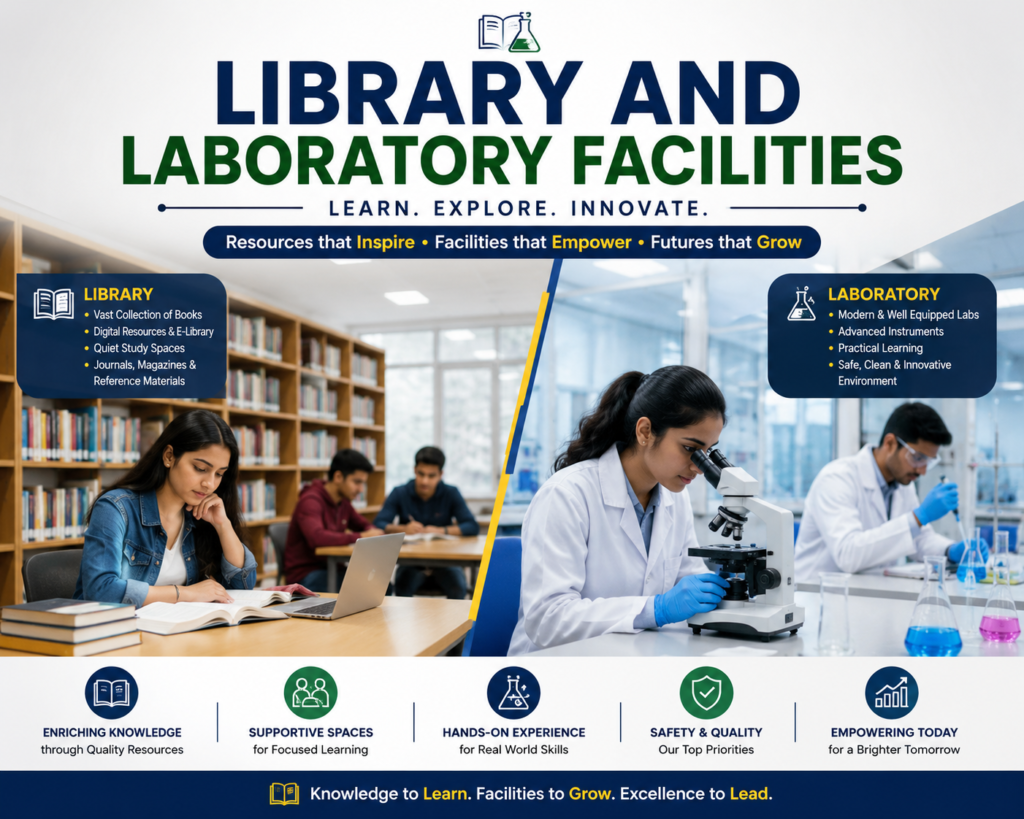
As a reputed Degree College in Etawah, CSSGI provides students with access to a well-maintained library that offers a wide collection of academic books, journals, digital resources, and reference materials. Students are encouraged to cultivate strong reading habits and develop research skills that support lifelong learning.
In addition, CSSGI offers well-equipped laboratories designed to provide practical exposure across various disciplines. Through hands-on learning, students gain valuable technical knowledge, improve analytical abilities, and strengthen their understanding of classroom concepts.
By combining experienced faculty, modern facilities, and a student-centred approach, CSSGI creates an environment where learners can achieve academic excellence while preparing for future career opportunities.
Conclusion
Library and laboratory facilities are fundamental pillars of quality higher education. While libraries nurture intellectual growth through reading and research, laboratories transform theoretical concepts into practical knowledge. Together, they create an engaging learning environment that prepares students for academic success, professional careers, and lifelong learning.
If you are searching for a reliable Degree College in Etawah, choose an institution that values both academic excellence and modern educational infrastructure. At CSSGI, students benefit from comprehensive library resources, advanced laboratory facilities, experienced faculty, and a supportive learning environment designed to help them succeed in every stage of their educational journey.